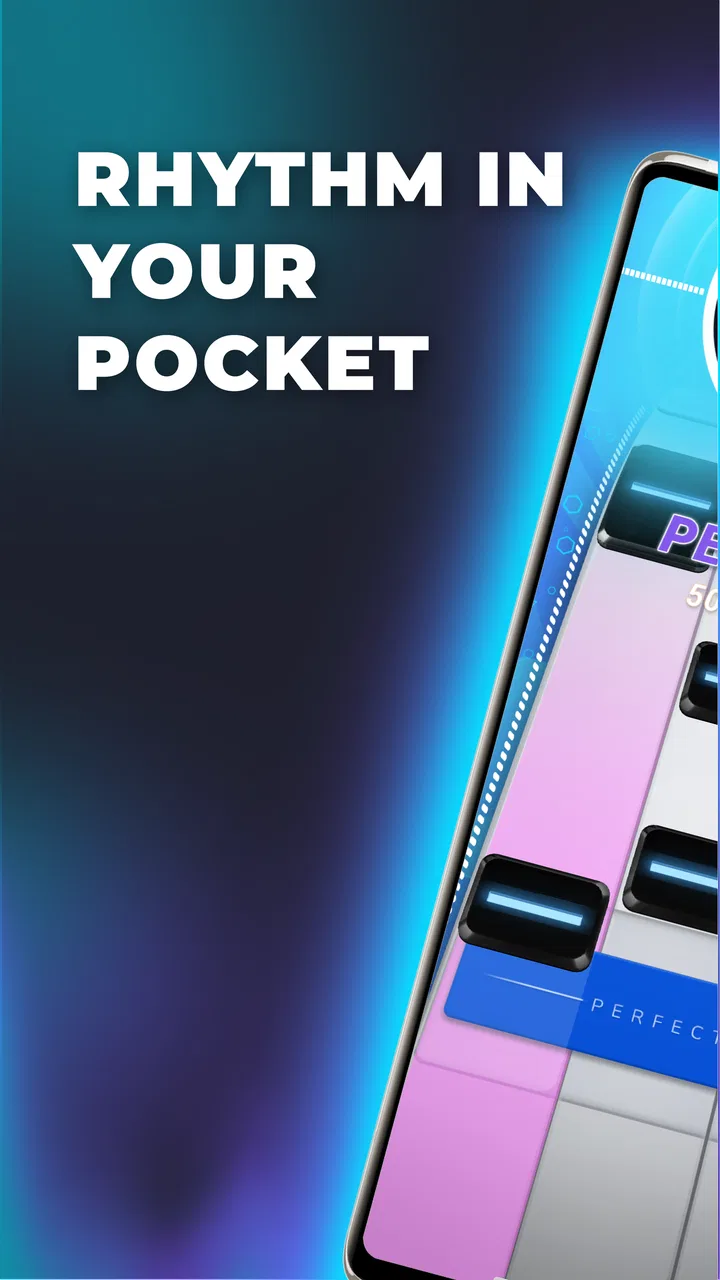
Beat Tiles: Music Game
- 4.6
- Rating
- 100.00K
- Installs
- Free
- Price

 Analysis by App-foxy
I spent time with Beat Tiles: Music Game as the kind of player who enjoys quick sessions rather than a long campaign. It is a free music game from Cadenverse, built around tapping beat tiles in time with the music. That description sounds simple, and the core really is easy to understand, but the appeal comes from how quickly a quiet moment can turn into a focused little rhythm challenge.
The game currently sits at a 4.5 average from around 1.1K ratings, with more than 100K installs. Those figures suggest that it has found a comfortable audience without pretending to be a massive music platform. I can see why: it is approachable, lightweight in concept, and suitable for casual play. At the same time, its simplicity means it will not satisfy everyone, especially players looking for deep song editing, a large social layer, or a full rhythm-game progression system.
How Beat Tiles feels in everyday play
The first thing I noticed is how little preparation the game seems to demand from the player. You do not need to learn a complicated control scheme before enjoying a round. The central task is to follow the beat and interact with the tiles as they appear, so the game communicates its idea through play rather than through a long explanation.
You May Also Like

 AccuWeather: Weather Radar
AccuWeather Review: A Quick, Clear Forecast for Everyday Decisions
For everyday plans, the best forecast is the one you can understand quickly. AccuWeather makes rain timing, radar, and local conditions easy to act on, with a few trade-offs.

 Hill Climb Racing
Why Hill Climb Racing Still Turns Crashes Into One More Run
A tiny car, a bumpy hill and one more upgrade: Hill Climb Racing keeps resurfacing because its simple chaos makes every near-miss feel personal.

 AliExpress - Shopping App
AliExpress Makes Global Shopping Feel Personal, but Shoppers Bear the Risk
AliExpress turns a global marketplace into a pocket-sized discovery engine. Its reach is useful, its shopping loop compelling, and its trade-offs easy to miss.

 Lords Mobile: Kingdom Wars
Lords Mobile Is a Kingdom-Building Routine, Not a Quick Match
A case-by-case verdict on the building, battles, device demands, and social commitments that make Lords Mobile rewarding for some players and exhausting for others.

 PDF Scanner app - TapScanner
TapScanner Makes Paperwork Easier to Capture, Check, and Share
TapScanner makes scanning with a phone feel less like a rescue operation and more like a dependable step in getting work done. Its capture tools are useful, though not flawless.

 Block Blast!
 Shows How Much a Puzzle Game Can Leave Out
A quiet grid game shows why puzzle players increasingly value instant clarity, repeatable skill and low-pressure play—and where the genre still needs to catch up.
More From Our News Desk
View All News


That makes it especially useful in short gaps during the day. I can imagine opening it while waiting for an appointment, taking a few attempts during a commute, or using it as a brief mental reset between more demanding tasks. A round can be treated as a complete activity instead of a commitment to a long session, which is one of its strongest qualities.
The music-game format also gives the taps a purpose. In an ordinary tile-matching or reflex game, a mistake may feel like a purely visual failure. Here, timing is the point. When my attention settles on the rhythm, the interaction feels more satisfying than simply pressing whatever appears next. The best moments come when the visual movement and the audio line up naturally.
That said, this is not the right choice for someone who wants a conventional music player with background listening, playlists, or artist discovery. It is a game first. The music supports the challenge, and the challenge determines how actively you must engage. If you want to relax with songs while barely touching the screen, a streaming service or passive music app will suit you better.
The learning curve is friendly, but mastery depends on focus
I would recommend beginning with a few relaxed attempts rather than treating the first session as a test of skill. Rhythm games often feel harder when the player watches every tile individually. A better approach is to let the pattern become a single visual stream and use the sound as a timing guide. That small change in attention can make the game feel less frantic.
Another useful habit is to avoid tapping too early. When a tile appears, my instinct is sometimes to react immediately, but rhythm play rewards waiting for the correct moment. Keeping the phone steady also helps. Unnecessary movement makes it harder to judge the next tile and can turn a manageable sequence into a messy one.
These are not complicated techniques, but they matter because the game’s appeal is tied to improvement. The first few rounds are about understanding the interaction. Later attempts are more about consistency, concentration, and recovering after a mistake. That gives the simple premise a little more staying power than the store summary alone would suggest.
A practical game for short sessions
One realistic use case is a ten-minute break at work. I would not open it when I need to keep half of my attention on an email or conversation, because rhythm gameplay works best when I can listen and watch properly. But during a deliberate break, it offers a clear boundary: play a few rounds, focus on the beat, then stop.
It also works well for players who dislike games that require daily maintenance. There is no need to describe it as a long-term lifestyle app. Its value is more immediate. You open it, play, and decide whether you want another attempt. That directness is refreshing compared with games that place several menus, currencies, and missions between the player and the actual activity.
Families may also appreciate the Everyone content rating, particularly when looking for a straightforward music-themed game. Younger players may still need guidance around in-app purchases, though, because the game is free to download and includes optional purchases priced from $5.99 to $39.99 per item. The age rating describes the content, not whether every purchase decision is suitable for every household.
What the current version says about its direction
The game was released on March 9, 2023, and the current version is 1.3.6. I see that version number as a sign of an established product that has moved beyond its initial launch build, rather than a brand-new experiment. It is sensible to judge the experience as a maintained casual game, while avoiding assumptions about future additions that have not been announced.
For someone who already plays it, the important point is that the current build should be treated as the reference experience. Advice based on an early launch version may no longer describe how the game feels now. If you are returning after a break, I would spend a few minutes reacquainting yourself with the tile timing before deciding whether the game has changed in a meaningful way.
The version information also helps set expectations for new players. This is not presented as an unfinished preview or a one-screen prototype. It has had time to settle into its identity as a beat-focused mobile game. Still, a version number alone does not promise a particular feature, song collection, or progression change, so I would focus on the current core loop rather than downloading it for a hoped-for future system.
From a user’s point of view, product evolution matters most when it improves the basic rhythm interaction without making the experience harder to understand. A good update for this type of game should preserve the quick start, keep the controls readable, and avoid burying the music challenge under extra layers. That is the standard I would use when judging later releases.
How existing players may experience the evolution
Players who have been using the game since earlier builds are likely to care less about the label of the update and more about whether sessions still feel dependable. A rhythm game lives or dies by the relationship between what the player hears, what appears on screen, and when a tap is expected. Even a small amount of friction in that relationship can be more noticeable here than in a slower puzzle game.
For that reason, returning players should pay attention to consistency rather than simply asking whether the game looks different. Does the timing feel natural? Can you read the next sequence without fighting the interface? Do short sessions remain convenient? Those questions reveal more about the practical effect of an update than a new menu or visual adjustment would.
New players have a different advantage: they encounter the current version without comparing it to an earlier one. I would suggest giving it several focused attempts before forming an opinion. A single rushed round can make any rhythm game seem unresponsive when the real problem is unfamiliar timing or playing in a distracting environment.
Playing with sound is another important consideration. Because the game is based on beats, muting the device removes part of the information that helps with timing. If you need a silent game for a waiting room or shared space, this may not be the most comfortable option. Using headphones can make the experience more personal, but I would keep the volume moderate and avoid playing when environmental awareness matters.
Where it compares well with familiar alternatives
Compared with traditional puzzle games, Beat Tiles offers a stronger sense of movement and timing. You are not only looking for a matching shape or planning a move several turns ahead; you are responding to a musical flow. That makes it a better choice when I want active concentration rather than a quiet logic exercise.
Compared with larger rhythm games, its likely advantage is approachability. Big rhythm titles often attract players through extensive song libraries, character systems, story content, rankings, or elaborate progression. Those features can be rewarding, but they can also create a lot of preparation around the actual music interaction. This game is more appealing when I want the central beat-tapping idea without committing to a broader entertainment ecosystem.
The trade-off is depth. A specialist rhythm-game fan may eventually want more variety, more control over difficulty, or a stronger reason to return after mastering familiar patterns. If your priority is a deep competitive ladder or a highly customizable music experience, a larger alternative may be the better investment of your time. Beat Tiles makes more sense as a focused casual option than as a replacement for every other music game.
It also differs from games that use music only as decoration. Here, the audio is part of the interaction, so the experience changes depending on whether you listen carefully or rely only on the screen. That gives it a more tactile identity than a standard arcade game, even though the underlying action remains easy to grasp.
Small habits that make the game more enjoyable
My first practical tip is to play in a consistent posture. Holding the phone at an awkward angle can make the tile path harder to read, especially when the pace increases. A stable grip leaves more attention for timing and reduces accidental taps caused by shifting the device.
Second, use short practice blocks instead of repeating attempts while frustrated. Rhythm mistakes often compound when I rush to recover from one missed tile. Taking a brief pause, listening to the next track or sequence with a calmer mindset, and then trying again is more productive than tapping harder and faster.
Third, separate sound problems from skill problems. If the music is difficult to hear, the room is noisy, or headphones introduce an uncomfortable listening experience, a poor round may not reflect your ability. Adjusting the environment before changing your technique is a useful troubleshooting step.
Finally, decide what you want from each session. If I play only to achieve a perfect run, the game can become tense quickly. If I play to improve timing or enjoy a few minutes of music-led interaction, the same result feels less punishing. That distinction is especially important for casual players who want a break rather than another source of pressure.
Limitations, purchases, and who should skip it
The free entry point is helpful, but the presence of in-app purchases means the experience should be approached with the same care as other free mobile games. The available purchase range is $5.99 to $39.99 per item, which is significant enough that I would not hand the phone to a child without checking purchase controls first. The game may be enjoyable without spending, but anyone uncomfortable with optional monetization should consider that before installing.
I would also skip it if you are looking for a rich music catalog, a story-driven game, or a detailed training mode. The central appeal is immediate rhythm interaction. Players who need extensive customization or long-term progression may find the experience too narrow once the novelty of tapping to the beat fades.
It is not ideal for every setting, either. Playing without sound can weaken the timing experience, and playing with sound may be inappropriate in quiet public places. It also demands more concentration than a game that can be played while watching television. That is a strength when you want focus, but a limitation when you want something almost passive.
Device compatibility is reasonably broad because the minimum operating system is Android 7.0. That makes it accessible to people who are not using the newest phone, although actual comfort can still depend on the screen, audio setup, and general responsiveness of the device. Rhythm games expose delays more clearly than many other genres, so a player with an older or poorly performing phone may judge the timing differently from someone on a newer device.
Another limitation is that the simple premise leaves little room for confusion but also little room to hide repetition. If the available patterns or musical variety do not keep you interested, there is no complex narrative to pull you back. I would treat it as a game for repeatable short challenges, not as a single purchase that guarantees months of discovery.
What I would watch in future updates
For future versions, I would pay attention to how Cadenverse protects the game’s most important quality: the feeling that a successful tap belongs to the beat. New content would be welcome, but it should not come at the expense of clear timing and quick access to play. A larger game is not automatically a better one if the basic interaction becomes crowded.
I would also watch how the product balances free play with its purchase options. The game benefits from being easy to try, and that goodwill is strongest when players understand what they are receiving before spending. Clear presentation and restrained friction would matter more to me than adding layers of monetized progression.
Existing users should watch for changes that affect their familiar routine. If an update alters the pace, interface, or way a session begins, even a small adjustment may change the feel of the game. New users, meanwhile, should judge the current build on its own terms and avoid assuming that a future update will add a feature they specifically want.
My overall view is positive but deliberately measured. Beat Tiles: Music Game is a good fit for someone who wants a free, accessible way to turn music into a short reflex challenge. I like its directness, its suitability for brief sessions, and the fact that the beat gives every tap a clear purpose. I would recommend trying it with sound on, a steady grip, and realistic expectations about depth.
I would not recommend it as a substitute for a full rhythm-game library or a conventional music service. Its strengths are concentrated in the moment-to-moment action, while its weaknesses appear when you ask it to provide a broader ecosystem. If that focused trade-off sounds appealing, the current version 1.3.6 is a sensible place to start. For me, it works best as a compact musical challenge: easy to pick up, rewarding when my timing improves, and honest about being a simple game rather than an all-purpose entertainment app.
FAQs for Beat Tiles: Music Game
01What is Beat Tiles: Music Game?
Beat Tiles: Music Game is an interactive rhythm-based game where players tap on tiles to the beat of popular songs. The game challenges players' timing and reflexes while offering an engaging audio-visual experience. It's designed for both casual players and music enthusiasts who enjoy a blend of gaming and music.
02Is Beat Tiles: Music Game free to play?
Yes, Beat Tiles: Music Game is free to download and play. However, it offers in-app purchases, such as additional songs or cosmetic items, which enhance the overall gameplay experience. Players can enjoy the game without spending money, although some content may be restricted to premium users.
03What are the system requirements for Beat Tiles: Music Game?
Beat Tiles: Music Game requires an Android or iOS device with a stable operating system version. For Android, a version 5.0 or higher is recommended, while iOS users should have iOS 10.0 or later. A device with decent processing power ensures smooth gameplay, especially for complex tracks.
04Can I play Beat Tiles: Music Game offline?
Beat Tiles: Music Game can be played offline, allowing users to enjoy the game without an internet connection. However, certain features, such as downloading new songs or accessing online leaderboards, require an active internet connection. Offline mode is perfect for playing on the go.
05Does Beat Tiles: Music Game have multiplayer options?
Currently, Beat Tiles: Music Game focuses on single-player experiences. While there is no direct multiplayer mode, players can compete against friends by comparing scores on leaderboards. Future updates may introduce more social features, allowing for more interactive competition among players.
Pros
- Engaging music tracks keep players hooked.
- Simple
- intuitive controls make it user-friendly.
- Visually appealing graphics enhance gameplay.
- Regular updates introduce new songs and features.
- Offline mode available for uninterrupted play.
Cons
- Ads can be intrusive during gameplay.
- Limited song selection without in-app purchases.
- Occasional lag on older devices.
- Gameplay can become repetitive over time.
- Requires significant storage space on devices.

Beat Tiles: Music Game
Gallery